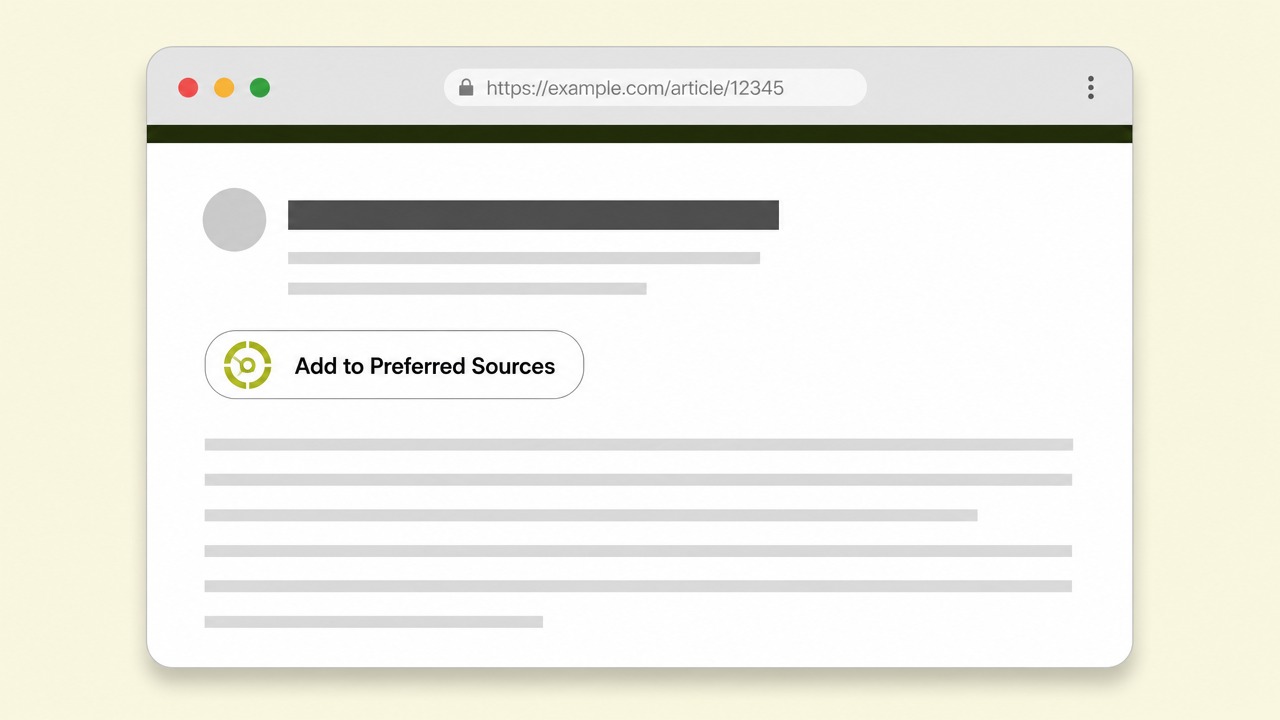
Google Preferred Sources is a button publishers can add to their site that lets a reader formally mark that site as a favorite across Google Search, Discover, and News, including Google's own AI Overviews and AI Mode. Google updated the feature on August 20, 2026: more than 600,000 unique sources have now been selected, up from roughly 345,000 in late May and about 90,000 the previous December, close to a sixfold increase in eight months, with most of the growth arriving after Google expanded the feature into AI surfaces in late May.
That growth curve is worth sitting with for a second. Google built a button whose entire function is "let me tell you I trust this source more than others," and 600,000 sites have already been chosen. For any brand, DTC or service-based, competing on educational content and earned expertise, that's not a footnote. That's a direct line to the exact behavior every content strategy is trying to produce: a reader who liked what they read enough to want more of it.
Why this is worth your attention as a DTC brand
Every AI visibility conversation tends to focus on being found. Preferred Sources is about being remembered. A reader who clicks "prefer" on your brand isn't a pageview. They're telling Google, in a durable and formal way, that your content earned their trust once and they want it to keep showing up. That's the same instinct behind a repeat customer, a newsletter subscriber, or someone who follows your brand on Instagram instead of scrolling past it. It's loyalty, captured in a place Google actually acts on.
And it's not just a loyalty metaphor. In the announcement that first launched Preferred Sources globally, Google reported that when someone picks a preferred source, they click through to that site roughly twice as often on average. That's a real, measured behavior change, not a soft benefit, and it's happening in the exact channel most DTC brands already depend on for organic traffic.
If you're a founder running content and marketing largely on your own, this is close to the best kind of tactic there is: no budget, no agency, five minutes of setup, and it converts one-time readers into people Google keeps routing back to you, without asking you to do anything differently in the content itself.
If you're further along and thinking in terms of channel mix and attribution, it's worth treating as a real relationship asset rather than a vanity add-on. It's a first-party signal of reader intent that Google is explicitly building its personalization systems around, and it compounds the same way an email list or a returning-customer base does: quietly, in the background, every time someone chooses you again.
And if you're building out a team and thinking about brand equity at scale, formal reader preference is one more durable signal sitting alongside the content, entity, and citation work already underway, a small piece of infrastructure worth having in place before the audience that will use it fully arrives.
What Google Preferred Sources actually does
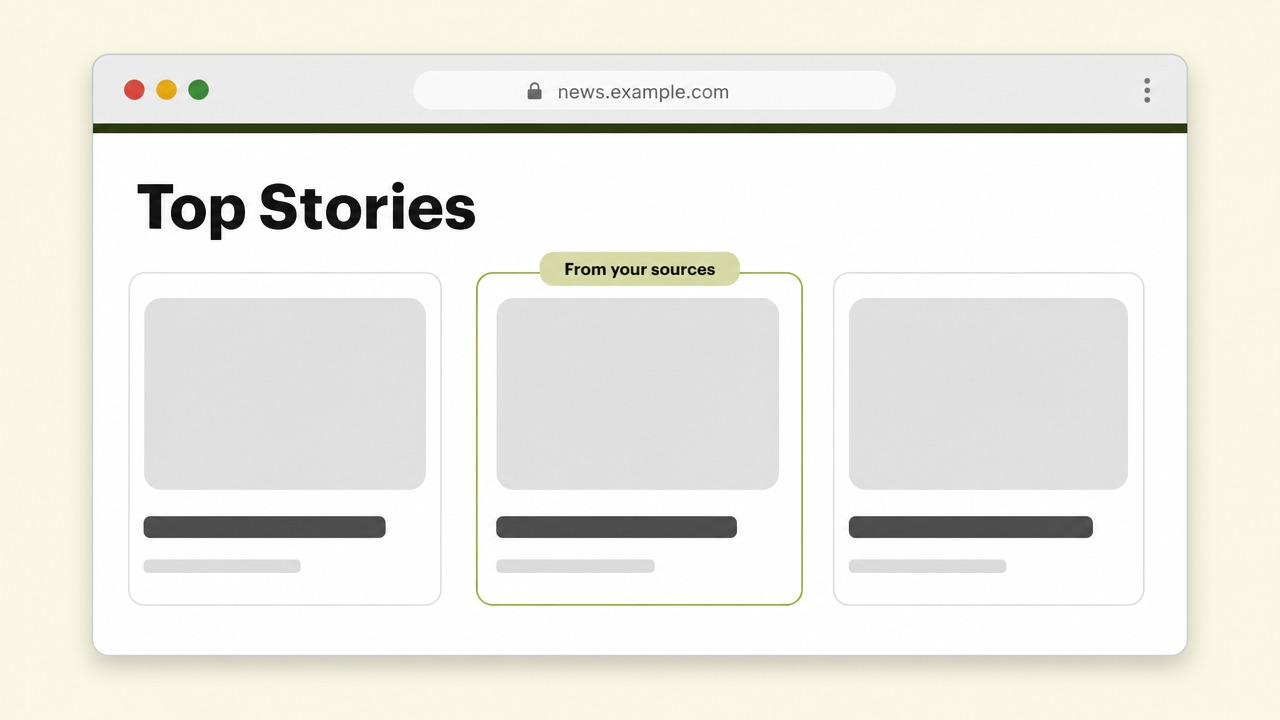
A reader clicks the button, and your site becomes one of their preferred sources. From then on, Google leans toward surfacing your content for that reader, in Top Stories, in Discover, and in AI-generated answers in AI Overviews and AI Mode, where a "preferred" label can appear next to your brand. Getting labeled "preferred" in an AI-generated answer, next to your name, in front of a reader who already chose you, is exactly the kind of visible trust marker that reinforces why they picked you in the first place.
How to add the Google Preferred Sources button
The only hard technical rule: it works at the domain or subdomain level. yourbrand.com or blog.yourbrand.com qualifies, but yourbrand.com/blog as a subdirectory doesn't. If you're curious whether Google already lists your site, you can search it directly in the source preferences tool at google.com/preferences/source. That's optional, not a requirement, and it has no bearing on whether you can add the button.
Google's Search Central documentation lists three ways to add the button itself, in order of ease:
- Standard embed (recommended): two lines of HTML: a script tag in your page's
<head>, and a<div google-add-preferred-source-btn></div>wherever you want the button to appear. Google renders it, localizes it to the reader's language automatically, and returns them to where they were on your page after they click. A theme setting switches it between light and dark. - Advanced JavaScript SDK: for a custom-designed button tied to your own trigger (a menu item, a modal, wherever fits your site) using Google's
preferredSource.init()andaddPreferredSource()methods. - Deeplink: for platforms that can't embed JavaScript: a plain link (
google.com/preferences/source?q=yourbrand.com) or a clickable image using Google's own downloadable button assets. Works in a blog post, an email footer, or a social bio.
No Search Console verification, no schema markup, no application to submit. Pick whichever option matches what your CMS actually lets you touch, and it's live in a few minutes.
One thing worth knowing before you set it and forget it: Google's own tool notes that sources that aren't updated regularly can become unavailable to select. Consistent publishing isn't just an SEO habit here. It's part of what keeps you available to select in a feature built to reward the readers who already trust you.
Add the button to your own site today. If this post earned enough trust that you're still reading, that's exactly the kind of reader Preferred Sources is built to keep.
Where it fits with everything else
Preferred Sources is Google-only. It doesn't extend to ChatGPT, Claude, Gemini, or Perplexity, so it's one piece of a multi-platform visibility strategy, not the whole thing. And it works alongside Google's normal ranking rather than replacing it, so it rewards a brand's existing reach rather than manufacturing new reach on its own. Neither of those is a knock against it. They're just why it belongs next to the entity clarity, structured content, and third-party corroboration work that decides whether an AI model or a search result surfaces a brand at all in the first place. Do that work, and Preferred Sources becomes one more compounding way for the readers already showing up to tell Google, and everyone who asks it a question, that they trust you.
Frequently asked questions
What is Google Preferred Sources?
A button publishers can add to their site that lets a reader select that site as a preferred source across Google Search, Discover, News, AI Overviews, and AI Mode, after which Google leans toward surfacing that publisher's content for that reader.
Why does Google Preferred Sources matter for building trust with customers?
Because it's a reader actively choosing to keep seeing your brand, not a passive metric. That formal preference works the same way a repeat purchase or an email subscription does. It's a durable signal that a brand earned real trust, and Google visibly reinforces it with a "preferred" label in AI Overviews and AI Mode.
Does the Google Preferred Sources button affect ChatGPT or other AI tools?
No. It's a Google-specific feature. It affects Google Search, Discover, News, AI Overviews, and AI Mode only. It has no effect on ChatGPT, Claude, Gemini, or Perplexity.
Do I need Search Console or schema markup to add the button?
No. Google's documentation confirms there's no verification step, no schema requirement, and no application process, just an embed code or a deeplink.
Is there a minimum traffic level to qualify for Google Preferred Sources?
No stated minimum. The requirement is domain- or subdomain-level ownership. Independent testing has confirmed the deeplink works on sites with under 1,000 monthly visitors.
Does adding the button actually increase clicks, or is "trust signal" just a metaphor?
It's measurable. In the announcement that launched Preferred Sources globally, Google reported that people who select a preferred source click through to it roughly twice as often on average.
The free AI Visibility and AEO Diagnostic
Preferred Sources is one real, low-effort way to turn readers who already trust your brand into a lasting, Google-recognized asset. It works best alongside the bigger shift already underway: AI answer engines and traditional search now run on different rules, and most DTC brands are only optimized for one of them. The free AI Visibility and AEO Diagnostic checks where your brand actually stands across 10–15 of your buying-intent queries on Google AI Overviews, AI Mode, ChatGPT, Claude, Gemini, and Perplexity, and names exactly which gap is costing you visibility.