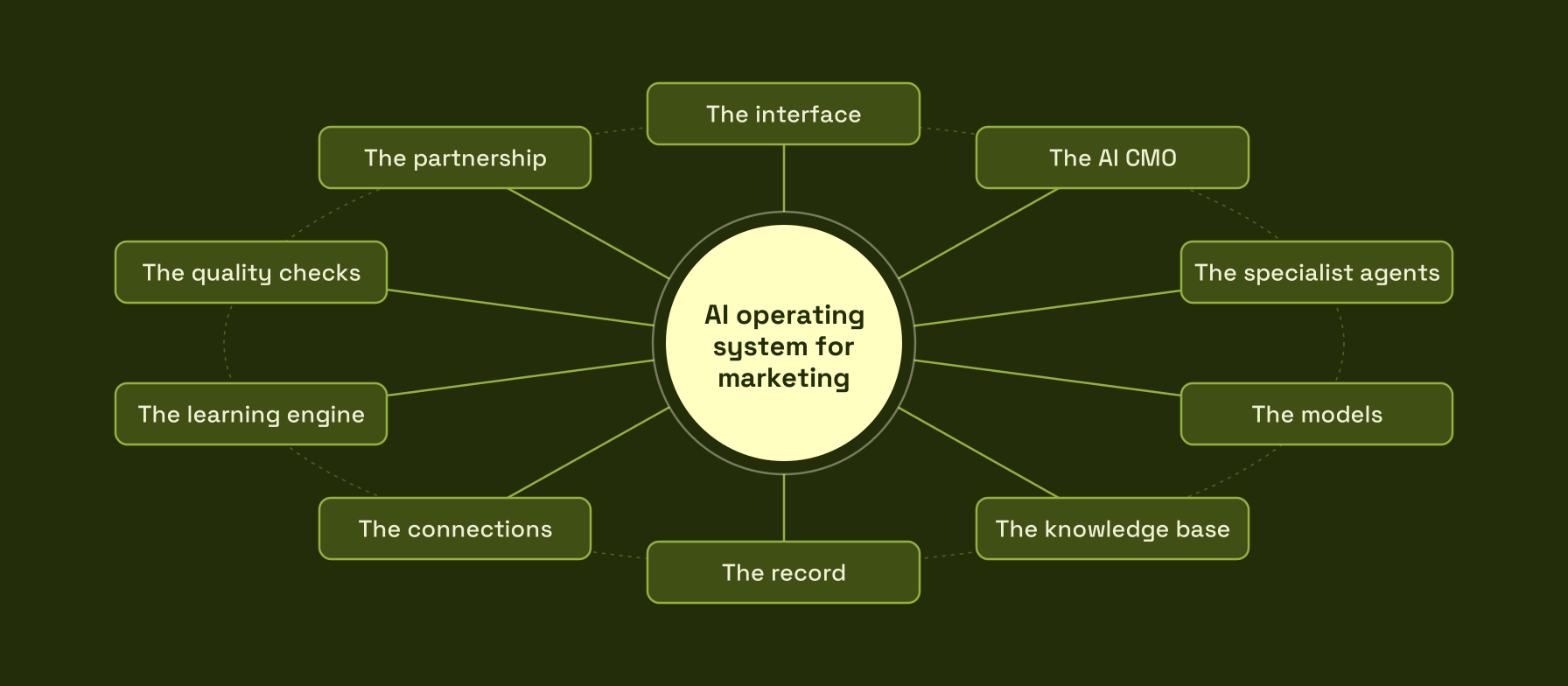
An AI operating system for marketing is one system of ten components that runs a brand's marketing as a department, with AI doing the execution and the founder keeping the judgment. It is not a collection of AI tools. It is a marketing department with an AI team inside it, and a founder who stays in charge.
The ten components are the interface, the AI CMO, the specialist agents, the models, the knowledge base, the record, the connections, the learning engine, the quality checks and the partnership. Here is how they fit together. You work through the interface in plain language. The AI CMO plans the job and briefs the specialist agents, eleven AI specialists with one job each. The knowledge base holds what the brand is, so nothing is explained twice, and the record keeps every decision with its reason. The quality checks review the work before you see it. The learning engine turns your decisions into proposed lessons you accept or reject, which is what makes it a self-improving marketing operating system. The partnership sets, task by task, how much AI does and what you keep. One idea holds all ten together: AI does the execution. You keep the judgment. The AI Marketing Assessment at the end of this guide shows how your own setup compares.
What is an AI operating system, and why build one for marketing?
A traditional operating system manages a computer's resources: memory, files and which program runs when. An AI operating system manages intelligence instead. As Articsledge's 2026 explainer describes it, it coordinates the models, orchestrates the agents, and sits between what a person intends and what the machines execute. It names three traits that separate it from a pile of tools. In marketing terms:
- It takes requests in plain language (conversational control). You say what you need, and the system decides who works on it.
- It remembers the brand (contextual awareness). Positioning, voice and past decisions carry from task to task.
- It finishes whole jobs (autonomous execution). Work moves from research to draft to review to live, with the founder approving at key points.
An AI operating system for marketing is that idea built for a marketing department, also called a marketing operating system.

Why is my brand's AI-generated marketing so generic?
Generic output usually comes from how AI is set up, not from the model. Five things go wrong when a brand runs on AI tools alone, and each has a component that answers it.
| What goes wrong | What it looks like on a normal Tuesday | What answers it |
|---|---|---|
| Every tool starts from zero, so you explain the brand again and again, and the output drifts off-voice. | You paste the brand voice into a fresh chat for the fourth time this week, and the caption still sounds like everyone else's. | One knowledge base the whole team reads (component 5) |
| Nothing checks the work. Drafts go straight out, or someone rewrites everything. | A draft goes out with a claim nobody sourced, or you spend your evening rewriting five drafts. | Quality checks built in (component 9) |
| Results never flow back, so the same mistakes repeat. | Last month's best post taught you something, nobody wrote it down, and this week's draft misses the same way. | The learning engine and the record of every decision (components 8 and 6) |
| It lives in one person's head. When they're busy, the system stops. | The one person who knows which prompt works is out, and nothing ships. | A written system: knowledge base, record and specialist agents with defined jobs (components 5, 6 and 3) |
| More tools, same bottleneck. Each new tool is one more thing to manage. | Seven tabs are open, and every one of them is waiting on you. | One front door, the AI CMO (component 2) |
The numbers show a gap between using AI and having it carry the work. In a survey of 1,256 owners in Goldman Sachs' 10,000 Small Businesses program, run by Babson College and David Binder Research from January 27 to February 4, 2026, 76% of the small business owners use AI, and 93% of those users say it has had a positive impact on their business. Only 14% say AI is fully embedded in their core operations, and 73% say they would benefit from additional access to training and implementation resources (Goldman Sachs press release, March 17, 2026). These are owners in that program, not small businesses in general.
Better results do not come from a better prompt. Write the brand down once, check the work, feed results back, and decide who does what. For a hands-on start, see setting up Claude for a DTC brand.
Why would a brand choose one system over separate AI agents?
A brand chooses a system when its marketing spans channels, several people touch it, and the brand voice and facts have to be right. Separate agents can each be good at one job; a system makes them a department. This compares setups, not companies.

| What it does | Where it stops | |
|---|---|---|
| A prompt or skill | Does one task when asked | Starts from zero every time, does not know the brand unless re-told, and nothing checks it |
| A single AI agent | Takes a goal and works out the steps | Works alone, with no shared memory, no review and no link to the rest of the marketing |
| An AI operating system for marketing | Runs the marketing as a department: specialists with owned roles, one knowledge base, an orchestrator, quality checks, a learning loop and clear decision rights for the founder | Strategy, positioning and taste stay with the founder, by design |
Six reasons a system wins:
- The brand is explained once. One knowledge base that all agents read answers generic output.
- Something checks the work. An agent that grades its own output has no second look.
- Results flow back. A lone agent finishes and forgets. A system turns results into lessons.
- It does not live in one head. The setup is written down.
- There is one front door. The founder talks to one point of contact.
- Decision rights are clear. Task by task, what AI does and what you keep.
When is one agent enough? When the work is one repeated task, done by one person, with low stakes. The balance tips when the work crosses channels, passes through several hands, or carries your name. For more on agents, read how AI agents are changing DTC brands.
Is my marketing AI-enabled or AI-first?
The World Economic Forum, with Kearney, gives each type of enterprise a litmus test in its 2026 blueprint. Two of the three tests apply to marketing, and they are a framework, not a statistic. Ask them about your own marketing:
If the AI tools were removed, would your workflows and organization structure collapse? If the answer is "no," your enterprise is AI-enabled
If AI systems were removed, could your business still operate (workflows, decisions, and delivery)? If the answer is "no," your enterprise is AI-first
Source: World Economic Forum with Kearney, The AI-First Operating System: A Blueprint for Operating and Business Model Innovation, June 2026, Table 1, "Enterprise archetypes by AI adoption," column "Litmus test."
A yes to the first question does not make a business AI-first. The report finds that AI laid over existing processes improves efficiency only at the margins, and that the real gains come from redesigning the work. Redesign is rare. In Deloitte's 2026 survey of 3,235 senior leaders at organizations on the leading edge of AI, cited by the World Economic Forum, 84% of companies had not redesigned jobs around AI, and only 25% of leaders said AI was having a transformative effect on their company.
Making AI how the work actually gets done means redesigning the work, with clear rules for what AI handles and what people keep. That redesign, for marketing, is what an AI operating system for marketing is. The AI Marketing Assessment turns these two questions into nine you can answer about your own setup.
What are the ten components of an AI operating system for marketing?
The ten components are the interface, the AI CMO, the specialist agents, the models, the knowledge base, the record, the connections, the learning engine, the quality checks and the partnership. Each answers a specific failure from the section above.

| Component | What it is | The pain it answers | Question to ask |
|---|---|---|---|
| 1. The interface | Where you ask in plain language and decide | Not knowing which tool to use | Can you ask for work in everyday words? |
| 2. The AI CMO | One front door that leads the team | More tools, same bottleneck | Is there one point of contact? |
| 3. The specialist agents | Eleven AI specialists, one job each | General answers to specific jobs | Does each job have an owner? |
| 4. The models | The right model for each task | Slow, costly or shallow work | Does the task decide the model? |
| 5. The knowledge base | The brand's memory | Every tool starts from zero | Is the brand written down once? |
| 6. The record | Every draft and decision, with reasons | Nothing can be traced | Can you trace any output? |
| 7. The connections | Links to the tools you already use | Work stuck outside real data | Does it work with your tools? |
| 8. The learning engine | Results become approved lessons | The same mistakes repeat | Do results change the next draft? |
| 9. The quality checks | Review no agent can skip | Nothing checks the work | Does someone other than the author check? |
| 10. The partnership | Who does what, task by task | Unclear decision rights | Do you set how much AI does? |
What is the interface, and how do I work with it?
The interface is where a founder asks for work in plain language, sets how much AI does, and approves, revises or rejects what comes back.
A request says the task, the goal and how much you want AI to do. For example: "Write three LinkedIn posts about AI search. The goal is more assessment completions. You and I work on this together." You do not choose which specialist to call. The system decides who is needed.
Each result arrives showing only the work to review, with the quality check's verdict beside it. You approve, revise or reject it, and you give a reason. A daily brief, a weekly summary and a monthly review keep you current.
Without it, you manage the system from the inside. Role in the system: it is where the founder gives direction and makes decisions.
Ask about your own setup: can you describe a job in a sentence and get one organized answer back?
What does the AI CMO do?
The AI CMO is the single front door that plans the work, briefs each specialist, passes work along and brings the founder one summary.
This is AI agent orchestration: one agent in charge of routing. The AI CMO reads the request, names the goal and sizes the job: one specialist for a small task, several in order for a larger one, and for a campaign, a plan shown to you first. It briefs each specialist on the objective, the output, the sources and the limits, then passes one agent's work to the next.
When the work comes back, the AI CMO checks that it fits the plan and the other pieces, and sends back what does not. It then gives you a summary, conclusion first, with a recommendation. It recommends and challenges. You decide.
The specialists do not message each other. The World Economic Forum's blueprint calls this the control layer: it routes tasks, applies policies and holds each agent's identity. Without it, you are the router. Role in the system: it is the control layer.
Ask about your own setup: who decides which tool does what, and in what order? If the answer is "me," that is the gap.
What do the specialist agents do?
The specialist agents are eleven AI specialists, each owning one marketing job and working from the same knowledge base.
These are AI agents for marketing with defined roles: search, content, campaigns, research, measurement, email, visuals, publishing and more. One only reviews work. Each is built on how its job is done in its field. Every agent is also responsible for the goal of its task, not just its piece of it, and it reports only what blocks or invalidates the task.
A defined job is more than a title. Each agent has one job, limits written down and a stated output, and the AI CMO briefs it on the objective, the output, the sources and the limits. If a task has no owner with limits like these, it has a tool, not an owner.
Without defined roles, you get a general answer to a specific job. Role in the system: they do the work of the department within their own jobs and limits.
Ask about your own setup: does each marketing job have a defined owner, with limits written down?
Why does an AI operating system use more than one model?
The models component matches each task to the AI model that suits it: heavier models for judgment, lighter and faster ones for repeat work.
Strategy, research, measurement and quality review need the most capable models, because a shallow read sends the plan the wrong way. Drafting and production run on lighter, faster models. The task decides the model.
The World Economic Forum's blueprint tells enterprises to treat the model layer as a portfolio, managing the trade-offs between performance, cost and reliability. The report says: "Frontier models are best suited to complex, high-judgement work; smaller models to repeatable, lower-cost tasks."
Without it, you pay for heavy thinking on routine tasks, or get shallow thinking where judgment matters. Role in the system: it matches the intelligence to the task.
Ask about your own setup: does the task decide which model is used, or whatever you opened first?
What is the knowledge base in an AI operating system?
The knowledge base is the brand's memory in one organized place: positioning, voice, proof, audience, offers, rules, decisions and what worked.
Every specialist starts from what is already known, so the brand is never re-explained. In our own build it is grouped by purpose, such as brand, proof, audience and rules. A ranked list says which source wins when two disagree, and each specialist reads only what its task needs. Corrections flow back in, so no specialist asks a question you have already answered.
Without a knowledge base, every tool starts from zero, and the output drifts off-voice. Role in the system: it is the shared context behind every task.
Ask about your own setup: is there one place you could point a new team member to for the brand's voice, proof and rules?
What is the record, and why does it matter?
The record is the complete log of what the system did: every draft, and every approval, revision and rejection with its reason.
It holds every task and draft, each decision and why, performance signals, the lessons and a log of every agent run. Each decision carries a reason and the size of the edit, so it is structured information, not a lost comment in a chat.
You can trace any output back to where it came from, and you can pause any agent at any time. The record also shows which kinds of work you approve untouched and which you keep rewriting, and the learning engine and the partnership both read that pattern.
Without it, you cannot answer "why did it write that?" or "what did we decide last time?" Role in the system: it is the system of record and the source of the learning.
Ask about your own setup: can you trace a published piece to who made it, who checked it and what you changed?
What are the connections to the tools I already use?
The connections let the system work through the analytics, search data, scheduling, email and website a brand already has, instead of replacing them.
The system reads real performance data from those tools and gets approved work live through them. Reading comes first: daily signals and a weekly summary bring in analytics and search data. Going live is controlled. In our own build, anything that goes to a customer's inbox waits for the founder to send it.
The World Economic Forum's blueprint explains why this holds up: core systems remain the source of truth, and AI sits on top.
Without the connections, the system works from guesses, and approved work has to be moved by hand. Role in the system: it reaches the brand's real data and gets approved work live.
Ask about your own setup: does your AI work from your real numbers and publish through your real channels?
How does a self-improving marketing operating system learn?
The learning engine is how a self-improving marketing operating system gets better: results come back, decisions become proposed lessons, and the founder approves what changes.
Performance data comes back on a schedule and is written back onto finished work. Each week the system turns your approvals, revisions and rejections, with their reasons, into proposed lessons. You accept or reject each one, and the accepted ones become rules the team follows. The World Economic Forum describes an intelligence engine that "grows smarter with use."
We put it this way: "It's a self-improving marketing operating system. It gets better every week, because every decision you make teaches it." And the limit: "Self-improving doesn't mean unsupervised. The system proposes how to get better. You approve what changes."
Without it, the same mistakes repeat. Role in the system: it is the flywheel.
Ask about your own setup: when a post works, or you fix a draft, does that change what the next draft does?
What do the quality checks catch?
The quality checks are a review no agent can skip: public-facing work is checked for voice, facts and fit before the founder sees it.
No agent grades its own work. A separate check runs on every piece a prospect, client or the public will read. It asks five things: does it sound like the brand, are the facts backed by a real source, does it do what was asked, does it follow its framework, and is it safe for the brand.
The check never rewrites. A failing piece goes back to the agent that made it, with the findings unchanged. Numbers come only from the brand's verified proof, so an unsourced claim does not get through on style alone. Every claim an agent reports points back to its source.
Without it, a confident wrong answer looks exactly like a right one. Role in the system: it is the trust layer.
Ask about your own setup: does anyone other than the person or tool that made it check the output before it goes public?
How does the partnership decide who does what?
The partnership is the set of rules that says, task by task, how much AI does and what the founder keeps.
"It's a partnership: for every task, we decide what you do, what AI does, and what you do together." The World Economic Forum's blueprint uses a levels of human agency scale to decide how people and AI share the work. It has five levels, and DLaurie AI runs on it. You state the level with each request. The examples are from our own system:
- AI does it on its own. Tagging, formatting, data pulls, reports, and format variants of approved work.
- AI does it, with your input at key points, and you approve. Social posts, email drafts and content briefs.
- You and AI work together as equals. Blog posts, landing pages, campaign plans and hero creative.
- You lead and AI helps. Campaign briefs, case studies and press.
- You do it. Positioning, pricing, strategy, sending email and spending money.
The level changes how the agents work. When AI does it, they ask only for information that exists nowhere in the brand's documents. When you work together, you approve the brief first. When you lead, they help when you ask. When you do it, they stay out. That is what keeping a human in the loop means in practice: a setting for each kind of work.
AI earns more independence only through approved work. Several weeks of approvals with little editing and strong quality checks move a task toward more independence, and you decide. An error in a claim or in compliance that reaches you, or three heavy edits in a row, moves it back toward closer oversight. Judgment, positioning, strategy and anything that carries your name stay with you.
Without it, either everything needs your approval and nothing speeds up, or nothing does and you find out later. Role in the system: it is the governance.
Ask about your own setup: for each kind of work, have you decided how much AI does, or does whoever opens the tool decide?
How do the ten components work together on one request?
Take an ordinary job: this week's blog post.
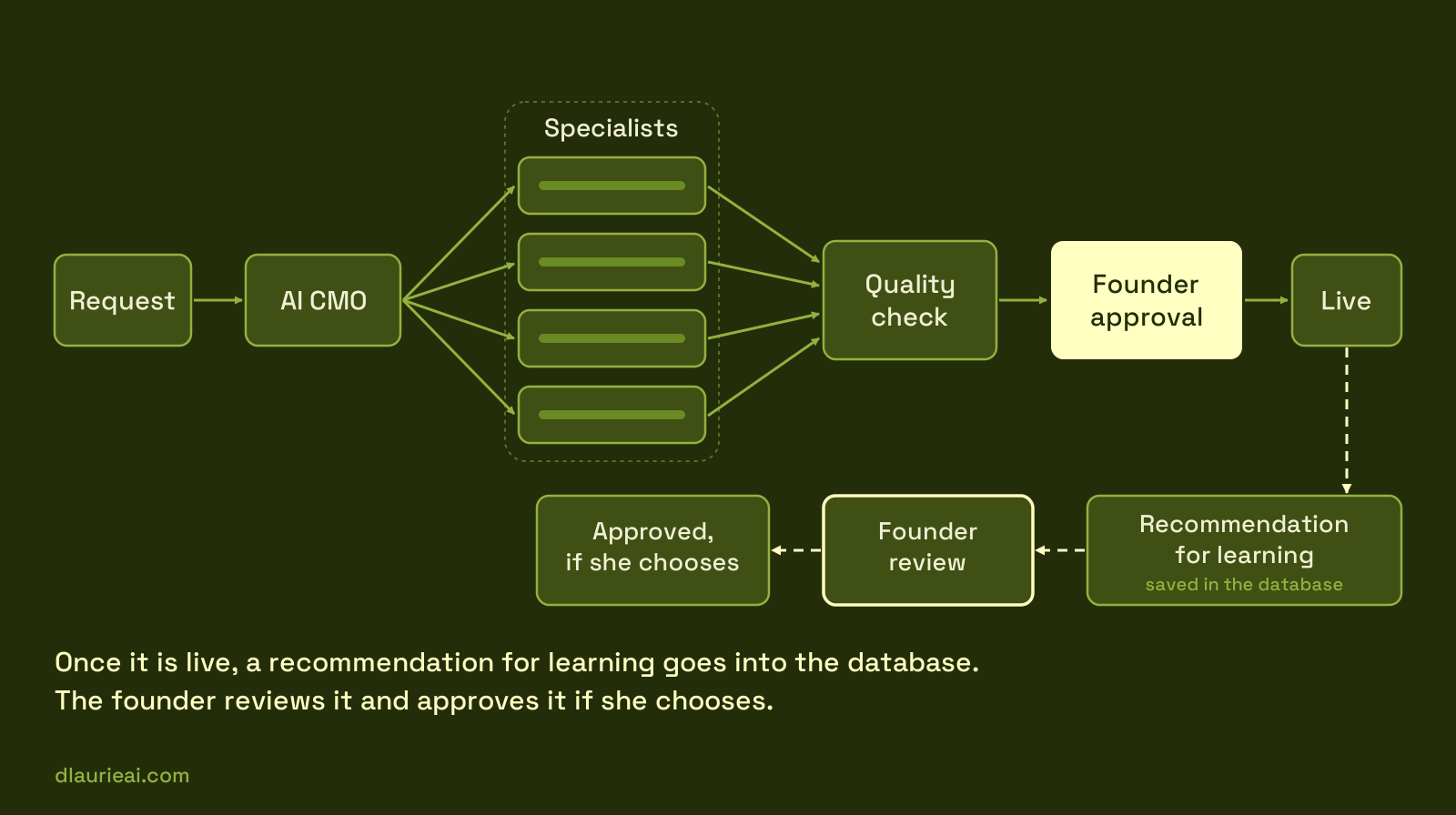
- You ask, through the interface. The task, the goal and how much AI does.
- The AI CMO briefs the specialists in order. Research, then brief, then copy, then visuals.
- Every specialist works from the knowledge base. The brand is not re-explained.
- The quality check runs. A failing piece goes back to be redone.
- You decide. You approve, revise or reject, and give a reason.
- It goes live through the connections. Approved work is published and checked.
- Results come back onto the finished piece and into the record.
- The learning engine proposes lessons. You accept or reject each.
The AI CMO passes the work from one specialist to the next. The specialists do not talk to each other, and none of them reviews its own output. Your judgment enters at two points: the request, and the approval. We built our own marketing department on it first.
Do I have to replace the marketing tools I already use?
No. Your analytics, search data, scheduling, email and website stay the source of truth, and the system sits on top of them. You decide what goes live, what stays a draft and what only you send.
Some products ask you to move everything into one platform. That is a different idea from an operating system for your marketing. The World Economic Forum's blueprint says core systems remain the source of truth, and AI sits on top.
How is an AI operating system for marketing built?
An AI operating system for marketing is built around the brand and designed with the team, task by task. This is how DLaurie AI builds the AI operating system for marketing:
- A discovery call. It shows what the brand needs.
- An audit. It covers the marketing infrastructure and baseline numbers.
- The design. How that brand's processes should flow. The design is part of the service, not a separate one.
- The build. The knowledge base, the record, the AI CMO and the specialist agents, in that order.
- Testing. The system runs before you rely on it.
- Training. Training the team is included.
The flow starts from the brand's marketing or campaign plan, with the founder at the top, not from individual workflows. Parts with workflows added on top are not an AI operating system.
What mistakes do brands make when they build one?
Seven mistakes are worth avoiding, and each maps to a component:
- Technology before strategy. Tools chosen before the plan.
- Poor or missing context. Agents with no brand memory produce generic work (the knowledge base).
- Taking people out of the decisions. Without set decision rights, you approve everything or nothing (the partnership).
- No check on the output. Confident wrong answers look like right ones (the quality checks).
- No way to learn. The same fixes come back every week (the record and the learning engine).
- No one to run it. The system stops when its builder is busy, which is why training matters (the interface and the specialist agents).
- Starting from workflows instead of the plan. The order matters more than the parts (the AI CMO).
How can I tell if my marketing is ready for a system?
Answer these ten questions about your own marketing. A "no" marks where a person is carrying what a component should carry.
- Interface: Can you ask for a whole job in everyday words?
- AI CMO: Is there one point of contact that plans the work?
- Specialist agents: Does each marketing job have a defined owner with written limits?
- Models: Does the type of task decide which model is used?
- Knowledge base: Are the brand's voice, proof and rules written down in one place?
- Record: Can you trace any published piece to its maker and checker?
- Connections: Does your AI work from your real analytics and channels?
- Learning engine: Do results and your corrections change what the next draft does?
- Quality checks: Does someone other than the author check public work?
- Partnership: For each kind of work, have you decided how much AI does and what you keep?
Start with one gap, not ten. Close that gap before you look at the next one.
The nine-question AI Marketing Assessment shows your result on screen, with no sign-up, and for each area one plain next step. To get a quick read, see how your system holds up.

Frequently asked questions
Is there an AI operating system for business?
Yes. An AI operating system is a layer that manages the models, agents and tools a business uses, and the World Economic Forum's June 2026 blueprint describes the AI-first operating system for enterprises. For marketing, DLaurie AI builds the AI operating system for marketing: ten components, one AI CMO, eleven specialist agents and a founder who approves the work.
What is the difference between an AI agent and an AI operating system for marketing?
An AI agent takes a goal and works out the steps, usually alone. An AI operating system for marketing runs the whole department: specialists with owned roles, one shared knowledge base, an AI CMO that briefs and directs them, quality checks, a learning loop and clear decision rights for the founder.
Can AI do my marketing for me?
AI can do the execution: research, drafting, production and reporting. It cannot do the judgment. Strategy, positioning, taste and anything that carries your name stay with you. In an AI operating system for marketing, you set task by task how much AI does and what you keep.
Can AI create a marketing strategy?
AI can research and draft a strategy for you to react to. In an AI operating system for marketing, the AI CMO recommends and challenges, and the founder decides. Strategy and positioning stay with you because they decide what everything else is for.
Do I need to replace my current marketing tools?
No. Your analytics, search data, scheduling, email and website stay the source of truth. The system works on top of them through its connections, and you keep control of what goes live and what only you send.
How does an AI operating system for marketing keep my brand voice?
The knowledge base holds your voice, with examples and rules, and every specialist reads it before it works. A quality check scores each public piece against that voice before you see it. Corrections you make flow back in, so the voice sharpens as you use it.
How does a self-improving marketing operating system get better over time?
Results come back on a schedule and are written onto finished work, and each week the system turns your approvals, revisions and rejections into proposed lessons. You accept or reject each one, and accepted lessons become rules the team follows. It proposes, and you approve what changes.
Who is an AI operating system for marketing for?
It is for founder-led brands that already use AI tools and want AI to carry more of the marketing: DTC, ecommerce, B2B and service brands. It fits when the work crosses channels, more than one person touches it, and the brand voice and facts matter. No headcount or revenue is required.
An AI operating system for marketing is a department, not a set of tools. You do not need all ten components on day one to see where you stand. Answer the ten questions above about your own setup, find the first "no," and start there. AI does the execution. You keep the judgment.
Sources
- World Economic Forum with Kearney, The AI-First Operating System: A Blueprint for Operating and Business Model Innovation, white paper, June 2026, Introduction, p. 6, Table 1: https://reports.weforum.org/docs/WEF_The_AI_First_Operating_System_A_Blueprint_for_Operating_and_Business_Model_Innovation_2026.pdf
- Articsledge, "What Is an AI Operating System? Transform Your Work in 2026," July 29, 2026: https://www.articsledge.com/post/artificial-intelligence-operating-system-ai-os
- Goldman Sachs, press release, "Small businesses embrace AI but need training and support to fully harness it," March 17, 2026: https://www.goldmansachs.com/pressroom/press-releases/2026/small-businesses-embrace-ai-but-need-training-and-support-to-fully-harness-it
- Deloitte AI Institute, State of AI in the Enterprise: The untapped edge, January 2026, pp. 10 and 13, cited by the World Economic Forum with Kearney (white paper, June 2026, p. 7, endnote 6): https://www.deloitte.com/content/dam/assets-shared/docs/about/2025/state-of-ai-2026-global.pdf